
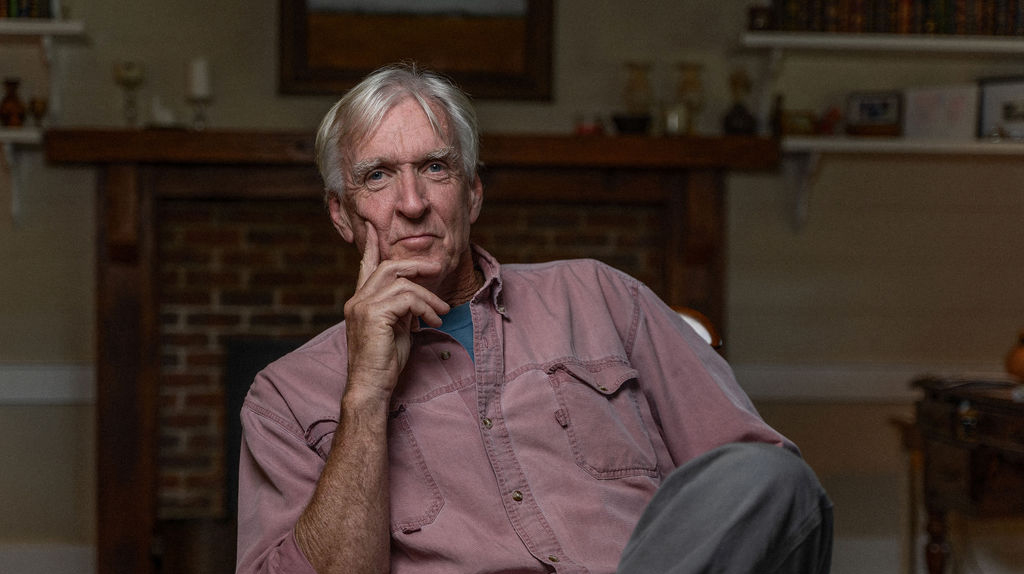
Theo of Golden quietly carries you to a small town that feels instantly familiar, the kind of place that lives in memory as much as it does on a map. Golden, the town at the heart of the novel, is modeled after a Georgia town rich with character. For me, it echoed the Savannah I grew up in twenty-five or thirty years ago: a place shaped by blue bloods and back streets, inherited power and everyday living—where those who claim to know a town often hold its secrets at arm’s length, while others walk its streets and carry its truths.
Allen Levi’s storytelling disarms you from the start, inviting you into this world, and anchoring it in the most unlikely and unforgettable guide: Theo, an 86-year-old man whom you fall in love with almost without realizing it.
At its core, Theo of Golden is a meditation on kindness, presence, and the radical act of seeing people fully. It reminds us that everyone is a someone, that every life holds a story far richer than the one we can make up in our minds, and that generosity is always the knock on the door we’re meant to answer. This is not a book for a specific kind of reader—it’s a book for humankind. A masterclass in empathy, and an invitation to finally get the credit you need to graduate from human school and go on to live accordingly.
-Laura Quick, Good Grit Founder
Many readers have said they felt “seen” or “comforted” by the book. What do you hope people carry with them after turning the last page?
I’ve been gratified that many have written to tell me that they enjoyed the story, which I suppose is something that most novelists would hope for. I’ve been surprised at how many have told me that they made themselves read it slowly.
I hope that by the time people reach the end of the book they’ll be happy that they read it, that they enjoyed the story and were given something worthwhile to think about. I would like to think that the book – the title character in particular — might be a disrupter of sorts, that it might — to use an ancient text — ‘provoke us to love and deeds’, and that it might make us kinder people. A number of our readers have said that they would like to be more like Theo — generous, hopeful, inquisitive, attentive. I would too. We live in a contentious time. I hope that Theo of Golden might give voice to ‘the better angels of our nature’ and allow us to better see the Imago Dei — the image of God — in those around us, no matter how different they might be from us.
Community, in all its imperfect, beautiful forms, plays a big role in Theo’s world. What do you believe small towns get right about belonging, and how did that influence your storytelling?
I grew up in a medium-sized city but spent lots of time in small town settings since my dad was a forester who managed timberlands in rural areas. As an adult, I’ve lived most of my life in a small town — presently around 1500 people — where I’ve had the good fortune of spending lots of time around good talkers, storytellers, blue-collar folk. Their voices, their humor, their faith and even their occasional eccentricities have undoubtedly colored the way I tell stories myself.
The word neighborliness seems largely outdated in a culture as transient as 21st-century America. I think, though, there are certainly places — maybe many more than I realize — where that trait still exists in generous measure. Small towns, or even distinct sections of bigger cities, especially those where there are multi-generational families and friendships, are fertile ground for neighborliness, where people know one another’s names and histories.
In Theo’s case, I think there is a lesson to be learned. Building and sustaining community takes work, time, and intention. That seems truer now more than ever. My small town, like many, is being changed by the ubiquity of screens and all the devices that allow us to be at home but a world away at the same time. Small towns with a healthy sense of community are to be applauded and encouraged every time they hold a family reunion, a dinner on the grounds, a Christmas pageant, or a turkey shoot. As old-fashioned as those traditions seem to be, they are the stuff of belonging.
Golden, Georgia, is as much a character in the book as Theo himself. What do you think travelers can learn about the South—and about themselves—by spending time in small towns like Golden?
It’s hard to generalize about small towns, given that each has its own personality, but I think a traveler might be struck by the slower pace of life, the absence of distraction, and a different, easier way of engaging with people. At least in my small hometown, one doesn’t have to work very hard to strike up conversation with a stranger. And laughter flows pretty unimpeded where I live.
I might suggest that one way to travel through and learn about small towns in the South is to read about them. Good Grit is a wonderful place to start. Two of my favorite writers are Wendell Berry and Rick Bragg. Their affection (and brutal honesty) for small towns provide interesting perspective on rural community. They paint ‘the glory and the grime’ of small town life, and isn’t it true that there is plenty of both in any town or city?
As for what one might learn about themselves from spending time in small towns, the possibilities are limitless. For someone altogether unfamiliar with small towns, they might just learn how narrow their view of the world is. (Same for a small towner going to a huge city.) They might discover that their perception of the South is based on caricature rather than reality; that there is a beauty and winsomeness in backroad America that deserves praise and preservation.
I’m presently re-reading a book by John Steinbeck, Travels with Charlie, published in 1961. In it, he expresses concern for the way that television and radio, of recent vintage at that time, were affecting regional personality. “Local is not gone but it is going.” He might like to know that, sixty-plus years later, there are still places where ‘local’ means something. Good Grit shines a spotlight on those places.
And because we always want to know what’s on a great storyteller’s nightstand: What books (especially by Southern authors) are you reading or recommending this spring?
At present, I am reading Marce Catlett by Wendell Berry, One Writer’s Beginnings by Eudora Welty, The Complete Essays of Mark Twain (edited by Charles Neider), and Charlotte’s Web by E.B. White (as a weekly volunteer reader for Mrs. Doughman’s 2nd Grade Class at Park Elementary School; the highlight of my weeks). I read the Bible every morning.
